

UAE E-Invoicing Is Becoming Mandatory. Is Your Business Ready?
Prepare for UAE E-Invoicing 2027 with GKA Chartered Accountants.
The UAE is introducing mandatory e-invoicing in phases, requiring businesses to adopt structured electronic invoices and appoint an Accredited Service Provider (ASP).
Whether your business has revenue above or below AED 50 million, GKA can help you understand your obligations, assess your accounting system, prepare your invoice data and plan for a smooth transition.
- Deadline assessment
- Accounting system review
- ASP selection support
- Implementation guidance
Get E-Invoicing Guidance for Your Business
Share a few details and our team can discuss your applicable deadline and next steps.
UAE E-Invoicing Deadlines — Two Important Phases
The applicable implementation date depends on your business revenue. Check your phase and start preparing before the mandatory deadline.
Phase 1 — Revenue AED 50 million or more
Appoint an ASP by 30 October 2026
until the ASP appointment deadline
Mandatory e-invoicing go-live
1 January 2027
For government entities, ASP appointment is due by 31 March 2027 and mandatory implementation starts on 1 October 2027. Deadlines are based on the Ministry of Finance implementation decisions, including the May 2026 amendment.
UAE E-Invoicing Timeline
Phase I: Large Businesses
Revenue ≥ AED 50 million
Appoint an Accredited Service Provider by 30 October 2026
Implement e-invoicing by 1 January 2027
Phase II: Other Businesses
Revenue < AED 50 million
Appoint an Accredited Service Provider by 31 March 2027
Implement e-invoicing by 1 July 2027
Phase III: Government Entities
Appoint an Accredited Service Provider by 31 March 2027
Implement e-invoicing by 1 October 2027
Don't wait until the deadline to review your accounting system and invoice processes.
What Is E-Invoicing in the UAE?
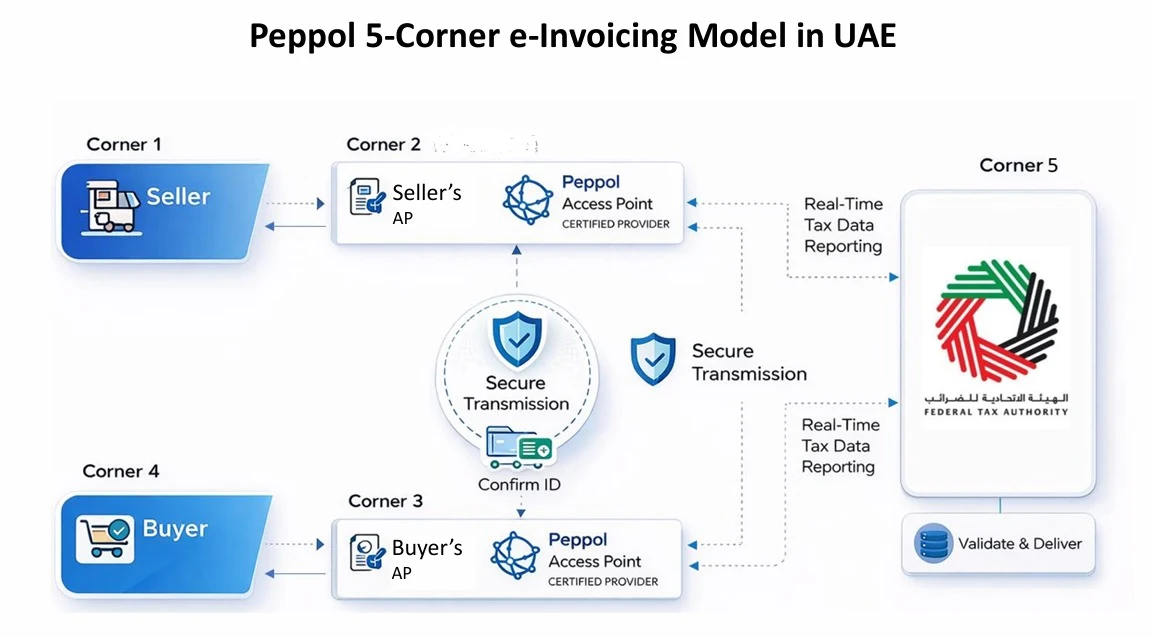
E-invoicing is a new way of issuing, exchanging and reporting invoices electronically using a standardised digital format.
Unlike regular PDF or paper invoices, e-invoices contain structured data that can be processed automatically through approved systems.
How e-invoicing works
Your business
Creates invoice
Accredited
Service Providers
Your customer
Receives invoice
In simple terms, your invoices will need to follow prescribed electronic standards, with invoice exchange and required tax data reporting facilitated through an Accredited Service Provider.
Does E-Invoicing Apply to Your Business?
The new requirements generally cover in-scope business-to-business (B2B) and business-to-government (B2G) transactions.
They may be relevant if you operate a:
- Mainland or Free Zone company
- Trading, contracting or manufacturing business
- Consultancy or professional services company
- Logistics, distribution or service business
- Business issuing invoices to corporate or government customers
What about B2C transactions?
Business-to-consumer transactions are currently excluded from mandatory e-invoicing until a further ministerial decision. Other applicable obligations should still be assessed based on your business activities.
Not VAT registered? That alone does not necessarily mean you are outside the e-invoicing requirements. Applicability depends on the relevant rules and transaction types.
How GKA Can Help Your Business Prepare
From understanding the requirements to coordinating implementation, GKA provides practical financial, tax and compliance support throughout your e-invoicing transition.
E-Invoicing Applicability & Deadline Assessment
Identify whether e-invoicing applies to your business, determine the relevant implementation phase and understand your key compliance obligations.
Accounting & Invoice Readiness Review
Review your invoicing procedures, customer and supplier information, VAT details and accounting records to identify gaps before implementation.
Accounting Software & ERP Assessment
Evaluate the readiness of your existing accounting software or ERP system and identify where updates, configuration or technical integration may be required.
Accredited Service Provider (ASP) Selection Support
Help you evaluate accredited providers based on compatibility, costs, support, invoice volume and business requirements.
Implementation & Compliance Coordination
Support your finance team in coordinating with the selected ASP or technology provider, preparing invoice data, reviewing processes and planning the transition.
One coordinated approach. Clear responsibilities. Better preparation.
Is Your Business Ready for E-Invoicing?
Many businesses may need more than a software upgrade. Your invoice records, VAT information and internal processes must also be ready.
Check where your business stands today.
0 of 6 completed
Preliminary self-check only
Your business may have important preparation tasks outstanding.
Discuss My Readiness with GKADelayed E-Invoicing Compliance May Lead to Penalties
Under Cabinet Decision No. 106 of 2025, administrative penalties apply to specified e-invoicing violations after the relevant requirements become mandatory.
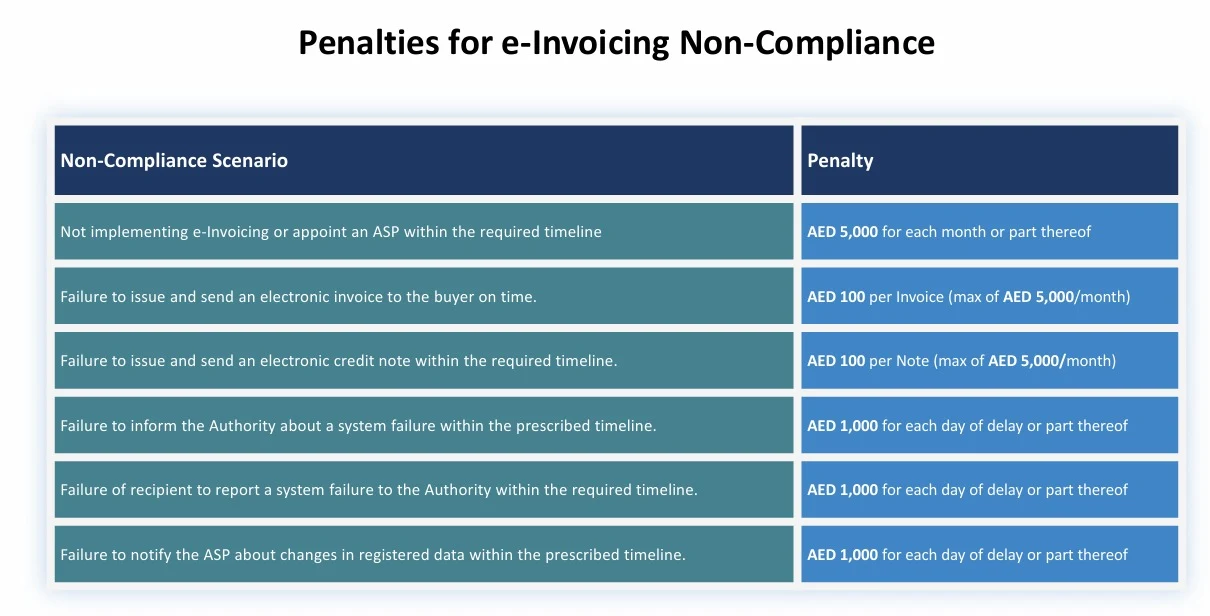
Penalties apply according to the specific violations, prescribed timelines and conditions under the applicable legislation.
Beyond penalties, inadequate preparation may result in invoice processing delays, rejected electronic invoices and operational disruption.
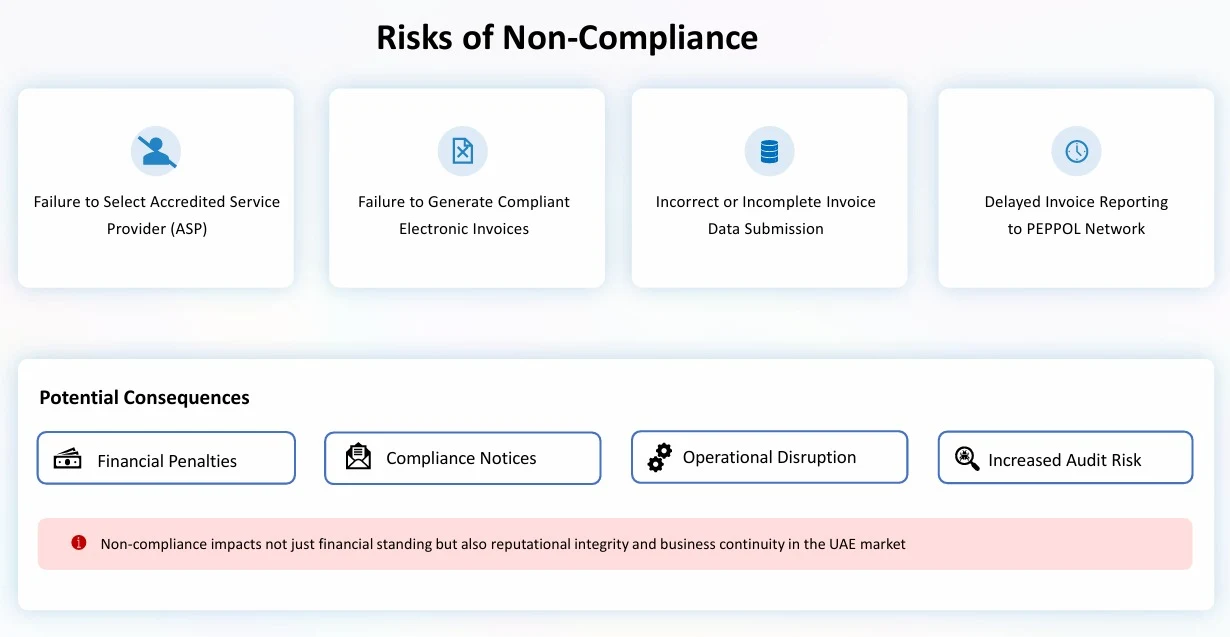
Prepare your systems, data and processes before your implementation date.
A Simple, Structured Approach to E-Invoicing Readiness
Understand Your Business
Review your activities, revenue, invoice volume and accounting software.
Identify Readiness Gaps
Assess invoicing processes, VAT data, software capabilities and compliance needs.
Plan the Transition
Help establish priorities, select an appropriate ASP and coordinate implementation.
Prepare for Go-Live
Support testing coordination, process reviews and compliance follow-up.
Why Choose GKA Chartered Accountants?
E-invoicing affects more than technology. It also affects VAT compliance, financial records, invoice accuracy and internal controls.
GKA combines accounting, taxation and regulatory experience to help businesses approach these changes with clarity and confidence.
Our focus is to help you make informed decisions, address readiness gaps and coordinate the transition with a suitable Accredited Service Provider.
Trust, Built on Precision.
Frequently Asked Questions
For in-scope businesses with revenue of AED 50 million or more, mandatory implementation starts on 1 January 2027. For those below AED 50 million, it starts on 1 July 2027.
The AED 50 million threshold is based on revenue, not net profit. The applicable definition considers gross income during the most recent accounting period, supported by financial statements or other acceptable documentation.
Yes, small businesses with in-scope transactions are generally covered under Phase 2, subject to applicable exclusions and rules.
Free Zone status does not automatically exempt a business. Applicability depends on the business and its transactions.
Possibly. Your software may require an update, integration with an ASP or changes to invoice data and processes. This should be assessed before implementation.
An ASP is a service provider accredited under the UAE framework to facilitate the exchange of electronic invoices and required tax data reporting.
Yes. GKA can assist with evaluating providers, reviewing accounting requirements and coordinating with your chosen accredited technology provider.
Not necessarily. That depends on your current system, the available integrations and the requirements of your chosen ASP.
GKA can assist with readiness assessments, data reviews, tax and accounting process preparation, ASP selection support and implementation coordination. Technical integration and regulated ASP functions must be performed by appropriately qualified technology providers.
E-Invoicing Deadlines Are Approaching. Start Preparing Today.
Your business needs more than a deadline reminder. It needs a clear understanding of what must change and how to prepare.
Let GKA Chartered Accountants help you assess your readiness and plan your next steps with confidence.
GKA Chartered Accountants | Trust, Built on Precision.